
Worry Time: Training Our Brain to Stop Holding Meetings All Day
Worry Reality Check
If your brain has been moonlighting as a horror trailer for future “what-ifs,” you’re not alone. Worrying is a natural part of being human. Our brains evolved to scan for threats, solve problems, and keep us safe. In small doses, worry can be helpful: it nudges us to prepare for a presentation, double-check an email, or look both ways before crossing the road.
Worry becomes unhelpful when it’s constant, repetitive, and focused on things we can’t control. It starts to behave like an over-sensitive smoke alarm, going off while we’re just toasting bread. Worry is intended to protect us, but it works best when it leads to action. When there’s no actionable step, it just ratchets up anxiety.
Why “Don’t Worry About It” Doesn’t Work
If you’ve tried not to think about something, say, a pink elephant (a fluffy pink elephant or a wrinkly pink elephant), chances are you’ve found it’s hard to turn thoughts off on demand. Thought suppression rebound is a concept that says the harder we try to push thoughts away, the louder they come back. So the aim isn’t to suppress worry entirely; it’s to change how we relate to it.
Why Worry Can Become Unhelpful
If worry were a colleague, it would be the one who schedules meetings at 3am, replays awkward moments from the past, and shouts “Urgent!” at the top of its lungs. Worry doesn’t stay in our thoughts; it shows up in our body, behaviour, and relationships. Sleep can suffer, decisions can stall, and we can become irritable or restless. For neurodivergent people, worry can mix with attention difficulties and sensory overload. For those with trauma histories, it can feel like constant vigilance.
Worry isn’t the enemy
Worry is a protective mechanism that has become overactive. The goal is to help it do what it’s meant to do, support us, without letting it take over.
The Evidence Behind Worry Time
Research supports the idea of scheduling time
Controllability matters: Worries about things we can influence may benefit from a concrete plan; worries outside our control are less likely to be productive if we stay in the moment with them.
Attention regulation: This approach helps us distinguish solvable problems from hypothetical concerns, turning manageable worries into concrete steps.
Value-based action: Uncovering the values being challenged beneath our worries can help us direct energy toward meaningful, action-oriented steps.
Postponement as a skill: Practising postponement reduces the emotional charge of our worries in the moment, making it easier to choose a path rather than react impulsively.
Exposure and reappraisal: Allowing time to confront our fears when we are less heightened can reduce our emotional response and enable us to examine evidence more calmly.
Stimulus control: In time, we can train our brain to choose when to worry, rather than letting worry choose the time for us.
Note: Worry time works best as part of a broader skills. It isn’t a stand-alone cure. There is no “perfect way” to do worry time. We need to tailor our timing, language, and activities to our own needs. What works well for one person may need tweaking for another.
How to do Worry Time
Capture worries during the day
Worry doesn’t have to hijack our day. When a worry arises, write it down in a notes app, notebook, or on a sticky note. Tell your brain something like:
“I hear you. I’ve put it on the agenda. We’ll deal with it during worry time.”
Schedule our worry like an appointment
Set aside a fixed 10–20 minutes each day to focus on worries. Practical tips:
Do it during daylight hours (our threat detection tends to be more alert in the light).
Avoid doing it right before bed to protect sleep.
Use structure to prevent spirals
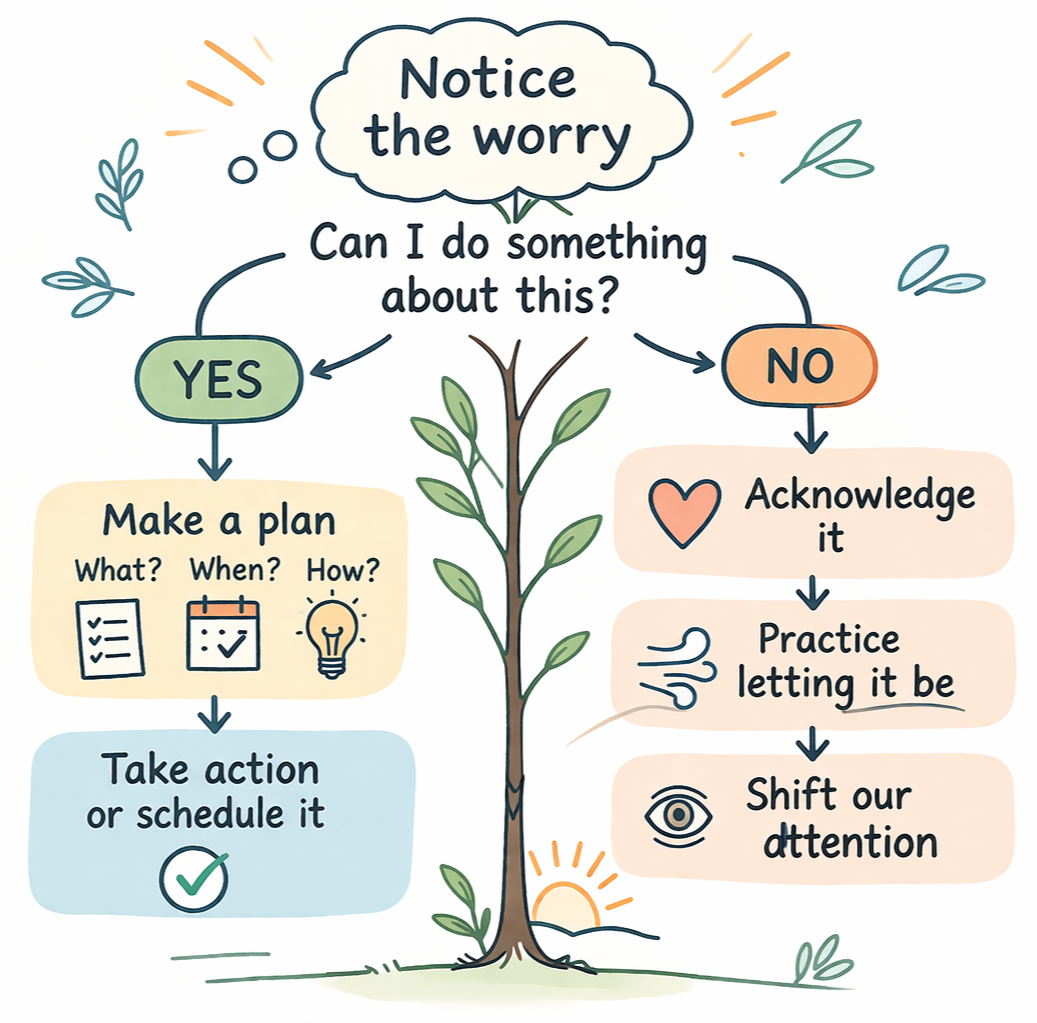
Unstructured worry can spiral quickly. Use a simple framework like the worry tree:
Can I do something about this?
If “Yes”, make a plan (What? When? How?) and take action or schedule it.
If “No”, acknowledge it, practise letting it be, and shift attention.
Check our unhelpful thoughts
When you notice a worry, pause and check it rather than spinning it further. Use a quick thought-check:
How likely is the outcome you’re worried about?
What evidence supports this worry? What evidence contradicts it?
Are there alternative explanations or outcomes?
What would I say to a friend who’s thinking this way?
Change the thought
If you find the thought isn’t helpful as is, reframe it into something more neutral or constructive. Examples:
“I’m prepared. I’ve done my best, and I’ll handle whatever comes.”
“I’ve faced similar challenges before, and I’ve managed to work things out.”
Use a thought record
Keep a short thought record to track evidence and refutations for trickier worries. It’s a practical tool that many therapists use when building cognitive flexibility.
End with a clear transition
When the timer ends:
Do something absorbing (a short walk, a recipe, a quick call with a friend).
Consciously shift your attention to the present moment. Think of it as closing the worry tab for the day.
Common Pitfalls and how to avoid them
Don’t turn worry time into rumination time. Use the worry tree to decide on action or postponement.
Keep expectations realistic. Worry won’t vanish, but it should interfere less with daily life.
Problem-solve where you can. If you can act, act; if you can’t, postpone and refocus.
Some worries can’t be solved. Acknowledge them and move on; you can’t control everything.
practical reminders
Some worries are uncertainty-based and may never be resolved. The aim isn’t to eliminate every thought but to reduce its impact and give you back control of our day.
If our worry is severely disruptive, sleep-disturbing, or accompanied by thoughts of self-harm, these can be signals to seek outside support.
The Takeaway
We don’t have to win every argument with our thoughts. Worry time isn’t about silencing the mind; it’s about giving our brain a clear, respectful schedule, a time to speak, a time to be quiet, and a time to act when it’s possible.
