
Chocolate, Cravings & the Brain: What Easter Teaches Us About Emotional Eating

It’s Not About Chocolate
Easter often brings chocolate, connection, and celebration, but for many of us, it also brings something quieter, confusion about cravings, eating patterns, or that familiar thought: “Why did I do that?”
If you’ve ever found yourself eating when you’re not physically hungry, feeling out of control around food, or stuck in a cycle of guilt and frustration, you’re not alone.
Many of us:
notice emotional or stress-related eating or other behaviours
feel stuck in patterns that don’t match our intentions
want to understand our behaviour without shame
Emotional eating isn’t random. It’s functional.
From a psychological perspective, emotional eating isn’t about willpower or “good vs bad”, it’s a coping strategy. Often it’s an attempt to regulate emotion. The behaviour isn’t the problem, it’s trying to solve a problem.
Think of your emotions like dashboard lights in a car. They’re not there to annoy you, they’re signalling that something needs attention. When our emotions feel too big, unclear, or overwhelming, our brain looks for relief.
Why Chocolate? What the Brain Is Doing
Highly palatable foods (like chocolate) activate the brain’s reward and relief systems, especially under stress. They happen to:
Be Readily available and provide rapid comfort
Be Socially acceptable
Be neurologically rewarding
Reduce emotional intensity temporarily
Shift our attention away from distress
The behaviour helps to solve a problem in the short term. So our brain learns: “This helps. Let’s do it again.”
How It Shows Up in Real Life
You’ve had a long Easter Sunday:
Lots of social interaction
Noise and stimulation
Maybe some awkward family dynamics
Later that evening:
You feel “off” but can’t quite name why
You’re not physically hungry
You start eating chocolate… and keep going
At first:
Your body softens
Your mind quiets
Later:
You feel flat, uncomfortable, or disconnected
The original feeling comes back
From the outside it looks like overeating, but from the inside our nervous system is just trying to settle. For many of us, especially those with trauma histories or neurodivergence, this pattern makes even more sense.
Emotional states don’t always show up as clear feelings. They can feel like:
tension
restlessness
sensations that I’m “not quite right”
By the time the behaviour happens, our system is already under pressure.
Understanding the Behaviour Cycle
In Dialectical Behavioural Therapy we map behaviours using a simple chain:
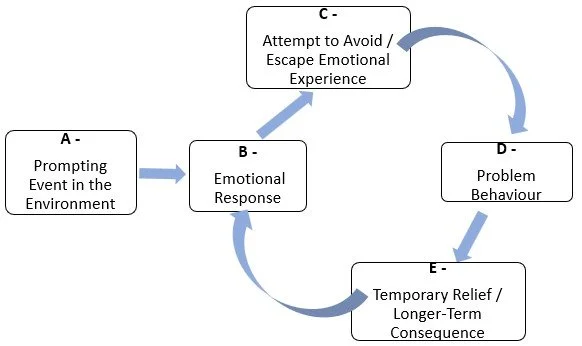
A – Prompting Event (Trigger)
Something happens (or builds over time):
A comment from a relative
Feeling excluded or overwhelmed
A difficult memory or internal thought
B – Emotional Response
Emotions or body states arise:
Shame, anxiety, sadness
Or a vague sense of “something feels off”
C – Attempt to Avoid
Our nervous system seeks relief:
“I don’t want to feel this”
Urge to numb, soothe, or distract
D – Behaviour
The action:
Eating chocolate
Snacking automatically
Eating past fullness
E – Consequences
Short-term: relief, numbness, calm
Long-term: guilt, disconnection, emotions return
This cycle repeats because it works in the short term to escape or soothe emotional distress .
A simple way to understand it:
It’s like using a credit card:
We get relief now
The cost comes later
And because the relief works, our brain keeps repeating the pattern.
From the Evidence
Research shows that emotional eating is strongly linked to challenges regulating our emotions, not just hunger. Recent studies highlight that:
High sugar and fat foods activate our dopamine-based reward pathways
These foods can temporarily reduce stress
Repeated pairing of emotion and food strengthens neural learning
There’s also evidence that emotional dysregulation plays a central role in maintaining binge behaviours, with eating used to cope with distress. Essentially, our brain is wired to remember what brings relief, even if it’s temporary.
What We Can Do About It (DBT-Informed Strategies)
The goal isn’t to “stop emotional eating overnight,” we are not trying to ignore or prevent our emotions, but instead we try to build respond to them differently. We want to develop new tools so that when the dashboard lights come on, we have more options than just reaching for the fastest off-switch.
Name What’s Happening (Awareness First)
· Instead of thinking “Why am I like this?”
· Try: “Something in me is trying to feel better right now.”
· Even naming the state helps regulate the brain.
Map Your Own Pattern
After an episode (not during), gently walk through:
What set this off?
What was I feeling?
What was I trying to avoid?
What did the behaviour give me?
Awareness builds insight without shame.
Meet the Need, Not Just the Urge
· If the urge is to eat, ask: “What might actually help me feel more settled?”
· Options might include:
· sensory soothing (warm shower, soft clothes)
· Gentle movement (walk, stretch)
· Music or low-stimulation time
· stepping away from stimulation
· connecting with a safe person
Create a Pause (Even 10 Seconds Counts)
· You don’t need to eliminate the urge, we’re just trying to slow it down.
Creating a pause between the thought and the action can help to expand our options
· Try: “I can eat this; I’ll just wait 10 seconds first.”
· Even a small shift matters. Accepting that “Part of me wants to eat because something feels unsettled,” creates space.
· That pause is where choice begins.
Expand Your Options (Not Remove the Old One)
· Instead of: “I can’t eat chocolate”
· Try: “Chocolate is one option. What else might help right now?”
· This reduces the “all-or-nothing” cycle.
Build Alternatives Gradually
Your toolkit should be about making small, realistic shifts:
Journalling or voice notes
Grounding (5 senses exercise)
Setting small boundaries
Self-validation
These build flexibility, not restriction.
Common Misunderstandings
“It’s just lack of willpower.”: In reality it’s about nervous system learning and reinforcement.
“I just need more discipline.”: Discipline doesn’t work well when our system is overwhelmed.
“I should stop the behaviour completely.”: We’re more successful when we focus on building alternatives first, rather than removing coping strategies abruptly.
A Diverse Lens
For many people, emotional eating is less about food and more about regulation. It may be linked to:
Sensory overload (common in autism)
Dopamine seeking and impulsivity (ADHD)
Difficulty identifying emotions (alexithymia)
Heightened threat systems (trauma histories)
This means the behaviour often makes even more sense, not less.
Easter as a Practice Opportunity
This Easter, if you find yourself reaching for another chocolate egg and you want to reconsider, pause for a moment. Not to judge yourself. Just to ask:
“What is my system trying to help me with right now?”
Because the behaviour:
made sense
worked (for a moment)
and developed for a reason
When we understand the pattern, we’re no longer stuck inside it. When we have more options, that is where change can begin.
