
The Responsibility Pie: Why You're Probably Carrying Way More Than Your Slice
Many of us have stayed awake at 2am running a highlight reel of something that went wrong, arriving at the conclusion that it was entirely, completely, and catastrophically our fault.
Many of us carry an invisible emotional backpack, often overstuffed, poorly balanced, and somehow containing not just our own stuff but everyone else's feelings, circumstances, and life outcomes too.
This tendency to claim full ownership of complicated situations shows up frequently if we’re lived with anxiety, depression, trauma, ADHD, autism, perfectionism, or relationship difficulties. Our brains are often very skilled at taking a messy, multi-layered situation involving multiple variables and simplifying into one single elegant, devastating answer:
"It was all my fault."
The Responsibility Pie is an exercise from Cognitive Behavioural Therapy (CBT) and trauma-informed approaches, designed to interrupt that pattern and help us separate what we feel responsible for from what we have control over. Often these things are not the same.
Why Our Brains Love Self-Blame (Even When It's Terrible for Us)
There’s something strangely compelling about self-blame. Not because it feels good or because it’s accurate, but because it can create a sense of certainty and control when something painful happens.
When a relationship ends, a friendship falls apart, conflict erupts at work, a child struggles, or burnout hits, the brain immediately starts searching for an explanation. And for many people, especially those shaped by trauma, chronic criticism, or environments where they were made to feel “too much,” “too sensitive,” or fundamentally out of place, the explanation our mind reaches for first is often:
“This happened because of me”.
Our brain does this to create the illusion of control. If the bad thing happened because of something we did, then theoretically we can prevent it from happening again. We just need to be better, try harder, say the right thing, anticipate everyone's needs, never make a mistake. All we need to do to avoid the mistake next time is to become a flawless emotional less robot.
The alternative is to accept that life contains uncertainty, that other people make their own choices, and that some painful things happen regardless of how hard we try, is genuinely frightening. Our brain prefers the option of:
"Quick, take the whole pizza. At least then we know and control what happened."
This pattern is common in trauma survivors, where internalised responsibility is a survival strategy. Children especially tend to personalise difficult experiences, "Dad is angry because I was annoying," "Mum is sad because of me", because developmentally, children see themselves as the centre of events. Those early beliefs can follow us quietly into adulthood, operating like background software nobody consented to install.
For neurodivergent individuals, years of masking, misunderstanding, and receiving subtle or explicit messages that something is fundamentally off about them can make self-blame feel almost reflexive. Like muscle memory. But significantly more exhausting.
Responsibility vs. Control
Feeling responsible for something is not the same as having the power to control or prevent it.
These two concepts are constantly tangled, and the tangle causes enormous pain. We might feel responsible for a loved one's anger, but we are not in control of another person's emotional regulation.
We might feel responsible for keeping everyone around us comfortable and happy, but we cannot fully control how others interpret our words, needs, or existence.
We might feel responsible for burning out, but chronic workplace stress, caregiving demands, financial pressure, sleep deprivation, and a neurological system running on empty are also in the room.
Responsibility and control overlap sometimes, but not always. Learning to tell the difference between "this is mine to carry" and "this was never mine to begin with" can dramatically reduce shame, which, as far as our burdens go, is one of the heaviest things we can lug around.
So, What Actually Is the Responsibility Pie?
Picture a pizza, a generous, family-sized pizza representing one difficult situation in your life. When we're distressed, our anxious brain tends to slide the entire pizza across the table and say, "Congratulations, this is all yours."
The Responsibility Pie exercise asks us to pause before eating the whole thing and instead ask:
“What are ALL the factors that actually contributed to this situation?”
We try to brainstorm every possible contributing element, not to avoid accountability, but to build a more accurate picture. This might include:
Other people's choices and behaviours
Miscommunication or differing communication styles
Timing (sometimes things happen at genuinely terrible moments)
Stress levels, yours and others'
Mental health challenges
Sleep deprivation (chronically underestimated as a factor in almost everything)
Trauma history
Family dynamics
Workplace culture or systemic pressures
Neurodivergence
Financial pressure
Unrealistic expectations placed on you by others or yourself
Pure bad luck
Actual weather (yes, sometimes it genuinely matters)
Your own actions and choices
Once you have your list, you estimate roughly what percentage of the situation each factor contributed, not with scientific precision, but with honest, reasonable reflection. Then you draw a circle and divide it into slices accordingly.
Accountability Vs Self-Attack
The Responsibility Pie is not about avoiding accountability, or convincing yourself that nothing was your fault and everyone else is to blame. That would be just as inaccurate as claiming the whole pizza, it would just be a different kind of distortion.
Genuine accountability, acknowledging your actual contribution to a situation, understanding what you might do differently, making repair where it's needed, is healthy and important. It's part of how we grow, maintain trust in relationships, and develop integrity.
For the Couples in the Room
Relationships can be a fertile ground for responsibility distortion, because when two people care deeply about each other, things get complicated quickly.
Consider a couple has an argument that escalates badly. Afterwards, one partner lies awake thinking, "I ruined everything. If I hadn't reacted the way I did, none of this would have happened." They've claimed 100% of the pizza, but a more honest Responsibility Pie for that argument might look something like this:
Contributing Factor and Approximate Share
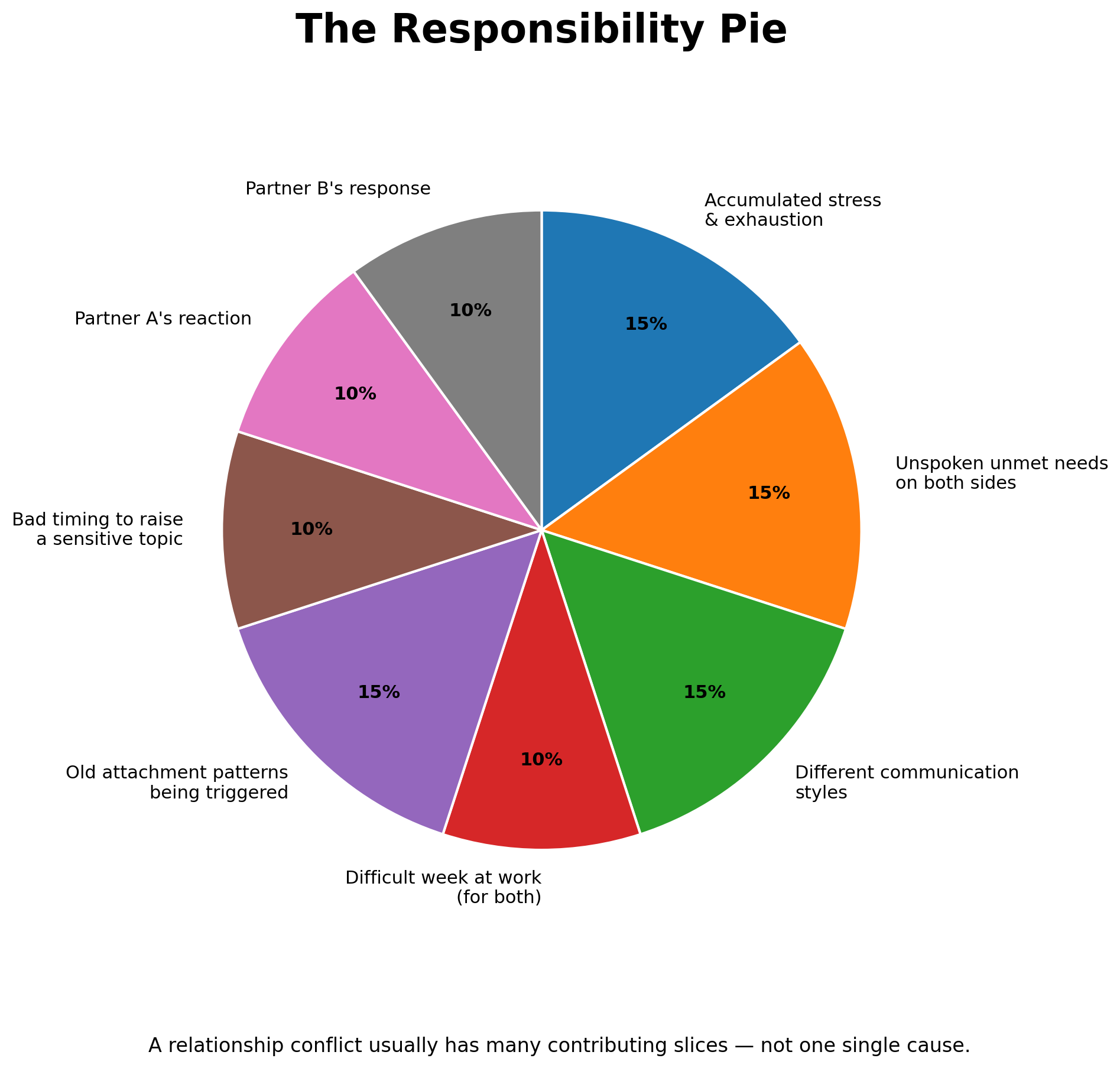
Accumulated stress and exhaustion - 15%
Unspoken unmet needs on both sides - 15%
Different communication styles - 15%
Difficult week at work (for both) - 10%
Old attachment patterns being triggered - 15%
Timing, bad moment to raise a sensitive topic - 10%
Partner A's reaction - 10%
Partner B's response - 10%
Both people have a slice, neither of them is the sole cause. Notice that stress, timing, history, and communication patterns, factors that belong to both of them also have seats at the table. This doesn't mean difficult behaviour gets a free pass, it means that when one partner habitually absorbs 100% of the blame after conflict, both people lose access to an honest account of what happened, and genuine repair becomes significantly harder.
The Responsibility Pie can shift the conversation from "who is the problem" to "what are the factors we're both navigating?"
How to Try This Yourself
Choose a specific situation, one that you find yourself ruminating on or feeling disproportionate guilt about.
Write it down plainly, just the facts of what happened, without editorial commentary about your character.
Brainstorm every contributing factor, aim for at least six to eight. Include people, circumstances, timing, systems, history, biology. Be genuinely curious rather than defensive.
Assign rough percentages, these don't need to add up perfectly. What matters is the relative weighting, not mathematical precision.
Draw the pie, there's something useful about making it visual. Your brain responds differently to seeing it represented spatially.
Locate your slice, acknowledge it honestly. What was genuinely within your control? What would you do differently?
Notice what the rest of the pie tells you, what factors were outside your control? What belonged to other people, to circumstance, to timing?
The goal is not to feel better by pretending your actions don't matter, but to hold yourself accountable to your actual share and put down the slices that were never yours.
The Bottom Line
Carrying the whole pizza everywhere isn't strength, or loyalty, it's an old strategy that made sense once, perhaps when taking responsibility felt like the only way to feel safe, to stay connected, or to maintain some sense of order in circumstances that were genuinely frightening, but most of us are long past those circumstances now, still lugging around a family-sized emotional order we never placed. The Responsibility Pie won't fix everything. But it might help you put down a few slices you've been gripping for years, and that is a very reasonable place to start.
