
It starts with something small like a wet towel on the bed, a text left unread, or the toilet paper loaded "wrong" (yes there's a wrong way).
Ten minutes later, you're both somewhere else entirely, going back over Christmas 2019 and wondering how a towel got you here.
If your arguments feel like you're dancing to the same old tune, you're probably not imagining it. Many couples don't have a hundred different fights. They have the same familiar dance, played out to a hundred different songs.
The steps may change slightly, but the pattern remains. One person pushes for answers, the other pulls away. One criticises, the other shuts down. Before long, both are caught in a dance neither intended to start, and neither quite knows how to stop.
The good news is that once you recognise the pattern, you can begin to change the steps. One practical tool for doing this comes from Schema Therapy for couples: the Mode Cycle Clash Card, or simply the Clash Card.
Old Maps, Familiar Steps
Psychologist Jeffrey Young developed Schema Therapy to help understand emotional patterns. We can think of a schema as an old map; a collection of beliefs, feelings and expectations shaped by our experiences, often from childhood, but also through later relationships.
If important people were unpredictable, we learn to watch for signs of rejection, if we experience criticism, even a small correction can feel like we’re being prosecuted or put on trial.
The trouble is that we can enter today's relationships still using yesterday's map. The landscape has changed, but our emotional compass keeps pointing towards familiar dangers, and when those old feelings get stirred up, we can find ourselves falling into steps we learned long ago, even when they no longer fit the situation.
It's worth remembering that everyone has schemas, including healthy ones shaped by experiences of safety, trust and belonging, and not every reaction comes from the past. Sometimes people really are being dismissive, unfair or hurtful.
The challenge is learning to recognise which tune is playing now and which one we're remembering. Are we responding to what's actually happening between us, or are we still doing the Macarena when the music has changed?
Meet the Dancers: Understanding "Modes"
If schemas are the old moves, modes are the different parts of us that show up when our feelings come to the surface. A mode is the emotional state we're in at a particular moment, influencing how we think and respond. We can think of four main characters who might appear on the dance card:
The Hurt Kid: The vulnerable part of us feeling lonely, rejected, frightened or not good enough; often the part carrying the deepest emotional need.
The Inner Critic: The harsh voice whispering, "You always stuff this up," or "They obviously don't care." It can turn a difficult moment into a judgement about our worth.
The Bodyguard: The protective part that rushes in when we feel threatened. It might attack, withdraw, people-please, over-explain or suddenly find our phone fascinating. Its job is to protect, even when it might create more problems.
The Healthy Adult: The calm, grounded part of us that can see what's happening, listen and take time to choose a response that reflects our values.
The challenge is that our Bodyguard may be very good at protecting us in the short term, but its familiar moves can trigger a part of our partner. Before anyone realises what's happening, they’re reacting to each other's protective steps rather than responding to the feelings underneath.
Meet the Clash Card: A Different Way to Look at Conflict
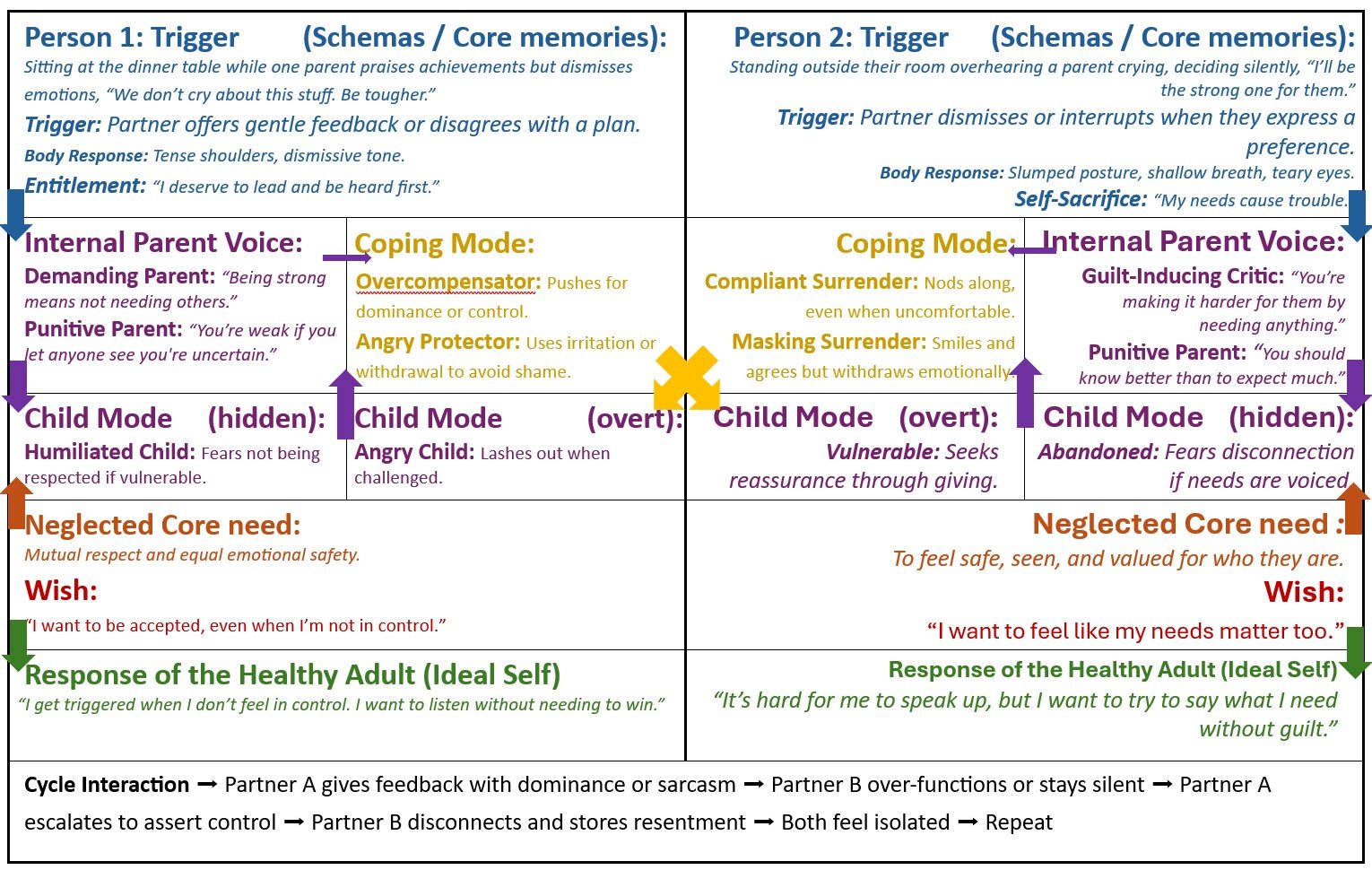
Eckhard Roediger and colleagues developed the Clash Card as a structured worksheet to help slow down a conflict, recognise the familiar steps you and your partner fall into, and understand what keeps the pattern going.
You can completed it together or explore your side on your own. Recognising how similar patterns have played out with important people in your life, like as caregivers, former partners or authority figures, can help you understand where some of your responses began and how you might change them. It takes two to tango, but only one to change the step.
Find Your Healthy Adult
Start at the shallow end, with a recent, moderate argument rather than the biggest blow-up of the decade. Wait until things feel cooler, and try to work through what you remember:
The trigger. What happened? Described as a camera would record it
"Alex replied five hours later" is a trigger.
"Alex ignored me because I don't matter" is an impression, not fact.
My feelings. Name the emotion underneath.
Was it hurt, fear, shame or loneliness?
Anger may be first on the Bodyguard’s dance card, but deeper feelings are often waiting for their turn.
My thoughts. What was your mind telling you? What was the song that kept playing?
"I'm not important."
"I can never get it right."
An old dance card. Does this feeling seem familiar?
Have you danced to this tune before, perhaps before this relationship began?
What old experiences might be shaping your steps today?
The Bodyguard's dance moves. When this feeling took the lead, how did you respond?
Did you criticise, withdraw, over-explain or give in?
What familiar steps did you fall into?
Changing the tune. Invite your Healthy Adult onto the dance floor.
How would you have liked to have reacted?
What could you try differently next time?
What might a fair-minded friend see differently?
If both partners are willing, fill in your cards separately and then swap and try to read your partner's version with curiosity rather than judgement. You may be surprised to find that their Bodyguard was protecting a Hurt Kid who looks a lot like your own.
Finding a Different Way Forward: Strategies to try
The Clash Card works best in hindsight, these are things you can try while the dance is going.
Recognise your Bodyguard's favourite moves.
When your Hurt Kid feels threatened, your Bodyguard steps in. Does yours criticise, withdraw, over-explain or give in to keep the peace?
Ask: "What is my Bodyguard trying to protect me from?" Its moves may have helped you cope in the past, even if they're causing problems now.
Notice when an old tune starts playing.
A small criticism might awaken an old feeling of inadequacy. A delayed reply might stir up fears of rejection.
Ask: "When have I felt this before, and what did I learn to do?"
Remember, not every reaction comes from an old map. Sometimes something genuinely hurtful is happening now.
Turn down the Inner Critic.
Your Inner Critic might whisper, "You're too needy" or "You always stuff things up."
Notice whether this leaves you feeling ashamed, defensive or desperate for reassurance.
Let your Healthy Adult offer another perspective: "I'm feeling rejected, but that doesn't mean I'm unlovable."
Listen to what your Hurt Kid needs.
Beneath your Bodyguard's protective moves may be a need for comfort, reassurance, connection, respect or safety.
Ask: "What do I actually need right now?"
Your Healthy Adult might offer self-compassion, make a clear request or set a boundary rather than automatically following the Bodyguard's lead.
Change one familiar step.
Look at your Clash Card and notice where your Bodyguard's response might keep the pattern going.
If you usually criticise, try asking a question. If you withdraw, explain when you'll return. If you give in, express one honest preference.
You can't control your partner's next step, but you can choose your own.
Practise a new step before the music starts.
Your Bodyguard has had years to rehearse its moves. Give your Healthy Adult some practice too.
Choose a familiar trigger and prepare a different response: "When I feel criticised, I'll ask for clarification before defending myself."
Practise when you're calm, then notice what changes. Learning a new dance takes repetition, not perfection.
Change the Dance, Not the Dancer
Disagreements are a natural part of close relationships, but fear should never have a place on your dance card. If you feel afraid of your partner, or are being controlled, threatened, monitored or hurt, this isn't simply a familiar dance you both need to change. Communication tools alone won't make an unsafe relationship safe.
In a healthy relationship, the goal isn't to change your partner, but to recognise the steps that keep you both caught in the same dance and learn a new rhythm together. Changing the dance takes two willing partners, and both need to feel safe enough to participate.
Sometimes Today's Argument Carries Yesterday's Fingerprints
Often relationships are less about two villains and more about two people bringing old experiences into the present, with their Bodyguards working overtime to keep them safe. If we can pause, recognise the familiar pattern and uncover the need beneath the reaction, we can create space new response. We don't have to keep following the same old steps. Sometimes, one small change is enough to begin a different ending.
