
Ikigai: A Japanese Idea About Understanding Purpose and Meaning
There is a particular kind of tiredness that has nothing to do with sleep. It shows up in the morning, in that brief moment before the day properly begins, the pause before getting up, where something in us asks a quiet question we can't quite name.
Why, exactly, am I doing this?
Not in a dramatic, crisis-laden way, but in a slow hum that can continue for months or years without ever fully reaching the surface. Many of us carry this question without realising. The Japanese concept of ikigai (pronounced ee-key-guy) combines two words: iki, meaning life or alive, and gai, meaning worth or benefit. Together, they gesture toward something like “a reason for being,” or more simply, a reason to get up in the morning.
Ikigai, Work, and the Question of Purpose
Ikigai can refer to many sources of meaning: hobbies, curiosity, family roles, community participation, craft, or ambition. For some of us it may include paid work or professional contribution, while for others it may be found in everyday activities that bring satisfaction or connection. Importantly, ikigai does not necessarily refer to career success or a single life mission. Research suggests that rather than one definitive answer, it often reflects a pattern of experiences that make life feel worthwhile.
Meaning may emerge through relationships, daily routines, contribution, and personal growth. People who report a stronger sense of ikigai often describe:
greater life satisfaction
lower depressive symptoms
stronger social engagement
a clearer sense that life has significance or direction
In this way, purpose is often less about discovering a hidden destiny and more about noticing the activities and relationships that continue to support a sense of vitality and involvement in life.
Why WE Begin Asking These Questions
Questions about purpose rarely appear in isolation. Many of us begin to wonder about direction when something in life has shifted faster than our existing roles or identities can keep up. This can happen during:
burnout or prolonged stress
mid-career reassessment
parenting transitions
illness or recovery
trauma or loss
redundancy or retirement
the late discovery of autism or ADHD
or other moments where our understanding of ourselves begins to change.
In these periods, uncertainty about direction is not necessarily evidence that something is wrong with us. Often it reflects the reality that capacities, values, responsibilities, or environments have changed. Psychology tends to view these moments with more nuance than the common advice to simply “find our passion.” A period of uncertainty does not mean we have failed to choose correctly. More often it reflects the fact that people change, roles change, and life circumstances place different demands on our attention, energy, and identity over time.
Research on purpose in life suggests that a sense of direction can fluctuate within the same person. These shifts are often linked with emotional experience, daily functioning, and the broader conditions of life. Daily experiences, health, relationships, and context all matter. That makes the search for meaning less like solving a riddle and more like noticing an evolving pattern.
When the Question Is Not “What Should I Do?” but “What Feels Worth Getting Up For?”
At different points in life, we may notice a quiet shift in how work or daily roles feel. A job or relationship that once made sense may start to feel heavy, confusing, or strangely empty. Sometimes nothing obvious has changed on the outside. The same role, the same tasks, and the same expectations remain, yet internally something feels slightly out of alignment.
We can arrive at questions about purpose in many ways. Sometimes it begins quietly:
“I can do this, but it doesn’t feel like me anymore.”
Other times it follows a more visible shift:
burnout or chronic stress
after illness or trauma
changes in life roles, such as separation or children leaving home
discovering a new diagnosis or part of ourselves later in life
moving into mid-career or later-life reflection.
In psychology, these moments are often understood as points of re-orientation. Research on meaning and identity suggests that people revisit questions of purpose across the lifespan. What once fit may gradually become misaligned with who we are now.
Living Ikigai Across a Life
Ikigai is not fixed. It is not a personality type, or a calling that must be honoured at all costs, it changes as we change. What gives a thirty-year-old a reason to get up may look quite different at fifty or seventy. The version of meaning available to someone in good health and stable circumstances may need to be re-imagined when those conditions shift. There is something quietly reassuring in this. It means the question does not need to be answered once and correctly. We can return to these questions as our lives continue to move and change.
Psychologist Michiko Kumano describes ikigai as a state of wellbeing that arises from devotion to activities one enjoys and that also bring a sense of fulfilment. The word devotion here is not about mastery or achievement. Instead, it suggests something closer to ongoing attention, care, and return.
A Way of Holding the Idea
Japanese neuroscientist and author Ken Mogi describes ikigai as having five core qualities:
starting small
accepting werself
connecting with others and the world
seeking small joys
being in the here and now.
In this way, meaning can be understood less like a single destination and more like a campfire.
Work may be one piece of wood, but so might friendship, curiosity, care, play, learning, contribution, culture, rest, or creative expression. Some pieces burn brightly for a season, while others provide quieter, steadier warmth. If one-piece changes, the whole fire does not necessarily go out.
This image softens the pressure that sometimes comes with the language of “finding our purpose.” Meaning is rarely discovered in a single revelation. More often it becomes visible through patterns: what draws our attention, what feels worthwhile, what supports vitality, and what allows a person to remain present in their own life. Seen this way, ikigai can function less as a framework and more as a set of questions:
What am I doing when I feel most like myself?
Where do I feel engaged, interested, or quietly alive?
Where do my strengths seem to be recognised or useful?
What would I find difficult to give up, even if no one was watching?
What connections or contributions feel meaningful in a quiet way?
Where does time seem to move differently?
These questions do not have correct answers. Instead, they offer a starting point for reflection, helping us notice what in our lives continues to matter and what we feel drawn to return to.
Where Meaning Often Comes From
The idea of ikigai often attracts attention because it captures a familiar question: how different parts of life come together to create a sense of direction. Psychological research suggests that meaning often grows from a combination of:
values
abilities
relationships
opportunities
and the practical conditions that support everyday life.
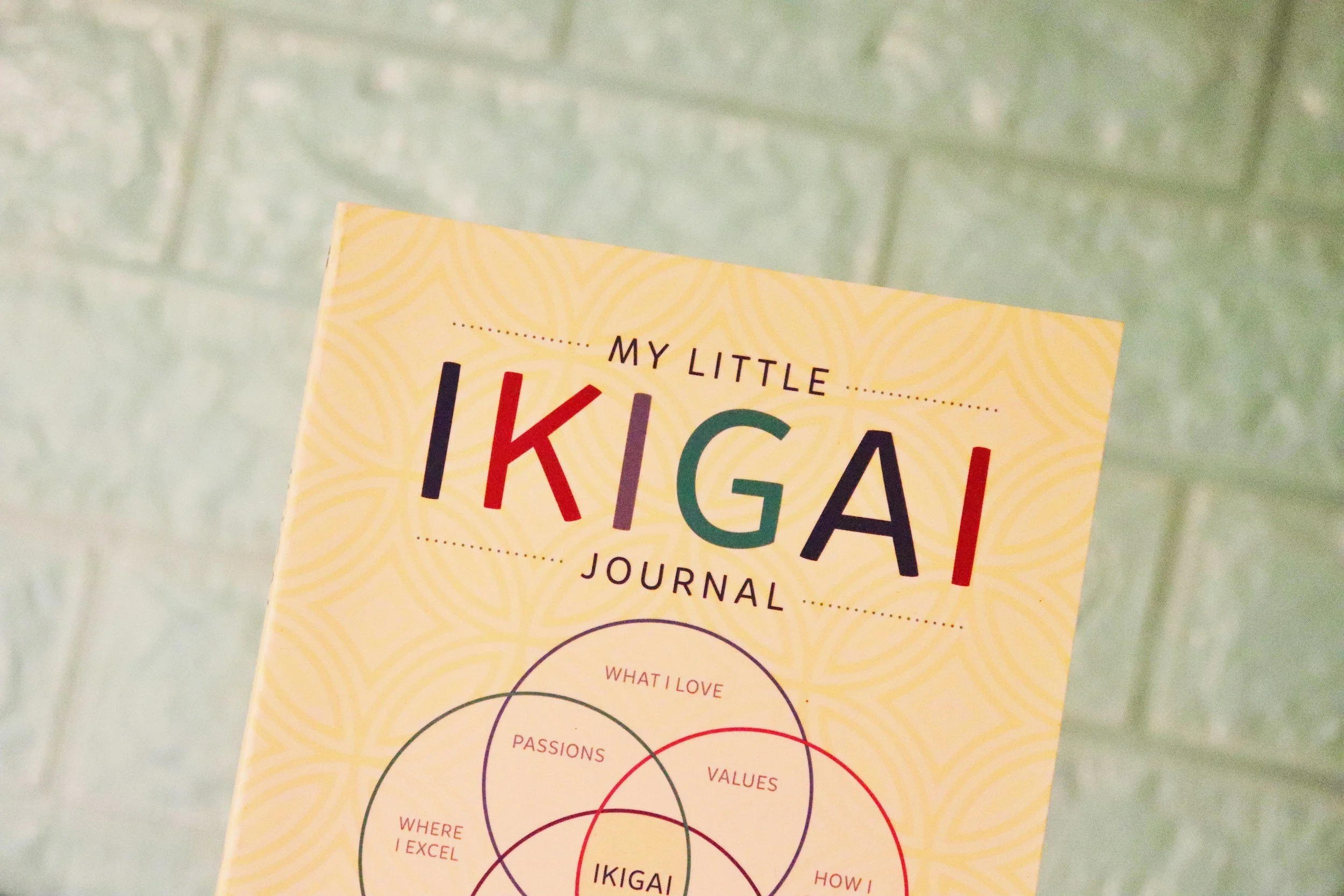
In popular culture, ikigai is sometimes represented as a four-circle diagram combining passion, mission, vocation, and profession. While this visual can be appealing, traditional Japanese understandings of ikigai tend to be simpler and more every day. Rather than a single perfect intersection, meaning is often found in small activities, relationships, and contributions that make life feel worthwhile.
Our lived experience of meaning is usually more flexible and varied than a diagram can capture. There is a common assumption that purpose should be clear, stable, and impressive. In reality, for many of us meaning is ordinary, evolving, and sometimes temporarily unclear. A sense of direction may grow gradually through daily routines, relationships, curiosity, creativity, and the roles we inhabit over time.
