
EMDR Therapy: Helping the Past Feel More Like the Past
Traumatic memories are notoriously bad at reading calendars. Something that happened five, ten or thirty years ago can come roaring back to life because of a smell, a tone of voice, a stretch of road, or a particular look on someone's face. Our rational brain knows:
"That happened in the past."
Meanwhile, our nervous system is shouting:
"Great input. Unfortunately, I've already declared an emergency."
This gap, between knowing something is over and feeling like it's still happening, is one of the central challenges in trauma therapy. It's also exactly what EMDR was designed to address.
What is EMDR?
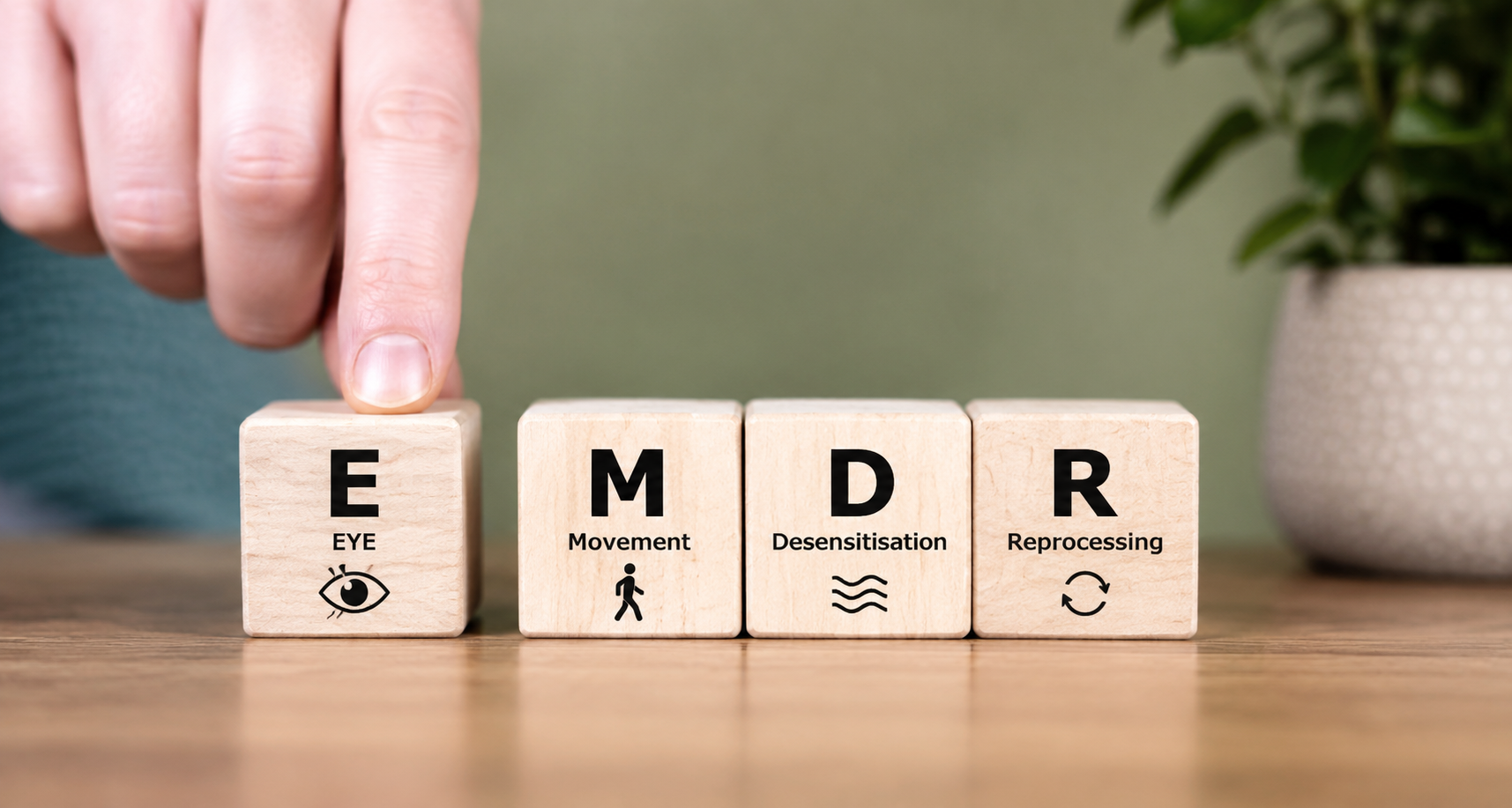
EMDR (Eye Movement Desensitisation and Reprocessing) is a structured therapy that helps people process distressing memories and reduce the emotional, physical and psychological reactions attached to them.
Despite the name, EMDR involves far more than wiggling your eyes side to side. The key mechanism is dual attention, briefly holding an aspect of a difficult memory in mind (an image, thought, emotion or body sensation) while simultaneously tracking something happening in the present, usually the therapist's moving fingers.
Part of your attention stays with the memory, while another part stays anchored in the here and now. You're not asked to relive the memory as though it's happening again, you're noticing it while staying aware that you're safe, in a room, in the present day. The therapist checks in regularly throughout, so it's not hypnosis, you remain fully awake and in control and there are no swinging pocket watches required.
Brain, Trauma and Autocomplete
Most of the time, predictive text is helpful, it spots patterns and saves us effort, but sometimes it learns the wrong lesson entirely. We type two letters and it's already decided it knows our whole sentence, even though we haven't finished thinking it.
After trauma, our threat system can do something similar. A tone of voice, a smell, or a certain kind of conflict might resemble something from an earlier, dangerous experience. Our nervous system recognises the pattern and fires off a prediction before we've had a chance to check whether it's actually relevant. Our rational mind says:
"This situation is different."
Our threat system replies:
"I've seen this movie. I know the ending."
EMDR aims to create space for our prediction to be updated. The goal isn't to erase what happened, or pretend it didn't matter, it's to help our brain tell the difference between "this reminds me of danger" and "I am in danger right now." Over time, the memory can stay part of our story without hijacking the way our body responds to the present.
Why The Eye Movements?
Researchers don't have one single, tidy explanation for the way EMDR works. Most often EMDR practitioners use the Adaptive Information Processing (AIP) model, which suggests that distressing memories don't get fully integrated with the rest of our life experience, so later reminders can trigger the original emotions and sensations. While it's a useful framework, but it’s not a literal description of how memories are physically stored in our brain.
Another explanation with experimental support involves working memory the brain space where we hold and work with information, think of it little like a mental desktop with limited space. Imagine trying to hold a vivid picture in your mind while, at the same time, adding several random numbers in your head. Both tasks require mental resources, so when you try to do them together, they compete for the limited capacity of working memory. The picture becomes harder to hold onto.
Something similar may happen during EMDR. Bringing a distressing memory to mind uses working-memory resources. At the same time, following something with your eyes, or completing another attention-demanding task, uses some of those resources too. Because your working memory has limited capacity, there are fewer resources available to keep the memory as vivid and emotionally intense while you are recalling it, opening a window for new learning.
Researchers believe there may be additional processes involved. Basically, they’ve found stronger evidence that EMDR helps PTSD any single explanation of exactly why it works. Our brains are impressive enough without letting the marketing department write the story.
What Usually Happens In EMDR?
EMDR follows eight phases, though that doesn't mean eight separate appointments.
History and treatment planning – understanding your difficulties, history, strengths and goals, and whether EMDR is a good fit.
Preparation – learning what to expect and building strategies for managing emotional activation.
Assessment – identifying a specific memory ("target"), along with associated images, emotions, body sensations and beliefs (like "I'm unsafe" or "it was my fault").
Desensitisation – briefly attending to the memory while completing sets of eye movements or another dual-attention task, checking in between sets.
Installation – strengthening a more helpful belief, such as shifting from "I'm powerless" to "I have choices now."
Body scan – noticing whether physical tension remains when thinking about the memory.
Closure – returning to emotional equilibrium before ending the session.
Re-evaluation – reviewing progress at later sessions.
The eye movements are just one ingredient in a much larger psychological recipe.
Does it Work?
For adults with PTSD, EMDR has a strong evidence base and is recommended in Australian and international treatment guidelines alongside several other trauma-focused cognitive therapies and prolonged exposure. These treatments differ in how they go about helping people recover. Some place greater emphasis on repeatedly approaching and processing the trauma memory, while others focus more explicitly on the meanings and beliefs that have developed around the experience.
Research shows EMDR has outcomes similar to other evidence-based PTSD therapies. While it’s not necessarily superior to these other treatments, therapy isn't the Melbourne Cup. One intervention doesn't need to win by three lengths for it to be worthwhile. A better question is usually: which evidence-based treatment fits you, your history, your preferences and goals?
The evidence for EMDR beyond PTSD is still developing and is not as strong for many of the other conditions it is sometimes marketed for. Not every painful memory is PTSD, and strong evidence for treating PTSD can't simply be photocopied and stapled onto every difficulty involving a distressing memory.
What about complex trauma?
There's a common myth that people with complex trauma must spend months or years becoming completely "stable" before starting trauma-focused therapy. The evidence suggests a more individualised picture.
Some people benefit from more preparation first, particularly where there's significant dissociation, safety concerns, or unstable circumstances. Others are ready to begin sooner. Good trauma therapy avoids two extremes: throwing someone in the deep end before they can swim or keeping them by the pool indefinitely because swimming feels uncomfortable. Readiness is about the individual.
Strategies you can Try
You don't need to process trauma alone to start changing how the past affects your present. These aren't DIY EMDR; they're awareness and grounding tools.
Ground yourself in the present.
When you notice overwhelm, anxiety or disconnection, bring attention back to now: feel your feet on the floor, name a few things you can see and hear, slow your breathing, and remind yourself,
"I'm noticing a reaction to danger, I can check whether I'm actually in danger now."
Ask: "Is this the past or the present?"
When something triggers a strong reaction, separate the alarm from the actual event:
My alarm says: "They're going to leave me."
What's actually happening: "My partner is upset and asked for space."
What's different now: "I'm an adult, this is a different relationship, and I can ask questions."
This isn't about talking yourself out of real feelings—it's about helping your brain make a more accurate read of now.
Map trigger, meaning, body and emotion then urge to respond.
Notice the sequence:
Trigger: First, identify what happened.
Meaning: Then notice what your mind made it mean, for example, “I’m not safe,” “They’re rejecting me.”
Body and Emotion: Next, notice the emotions and sensations that follow, such as anxiety, anger, tightness, or tension.
Urge to Respond: Finally, notice what you feel pulled to do, withdraw, argue, avoid, please, or seek reassurance.
Seeing the sequence helps you distinguish an old alarm from what is actually happening now.
For example: If your partner replies late; your mind might says "they're leaving me"; your chest tightens; you send six urgent messages; they withdraw, feeling overwhelmed, and your original fear feels confirmed.
Instead of judging the reaction, get curious: "What earlier experience taught my nervous system that this means danger?"
Recognising Boundaries
These tools are for awareness and grounding, not memory processing. If focusing on the past leads to intense distress, panic, dissociation or difficulty returning to the present, stop and ground yourself, then discuss memory work with an appropriately trained psychologist.
Could EMDR be right for me?
It may be worth discussing if intrusive memories, nightmares, avoidance or trauma-related beliefs continue affecting your life. But experiencing trauma doesn't automatically mean you need EMDR specifically. A good therapist will consider your safety, symptoms, preferences and circumstances, and welcome questions like:
"What makes EMDR appropriate for my difficulties?"
"What happens if I become overwhelmed?"
"What's your experience using EMDR with concerns like mine?"
Helping the past become the past
EMDR doesn't delete memories or rewrite history. What it may do is change the relationship between a distressing memory and the present. Not "it never happened," but "it happened, it mattered, but it isn't happening now." For a nervous system that's spent years treating yesterday's danger like today's breaking news, that shift can matter enormously. Sometimes helping your brain update its calendar is a very good place to start.
